19 products from trusted UK retailers
8x42 binoculars are the all-round size most birders reach for first: eight times magnification through 42mm front lenses gives a wide, bright, steady view that works in woodland, on the coast and in the garden. Every pair here is a waterproof roof prism model with ED or HD glass, from Hawke, RSPB, GPO, Kowa, Viking, Celestron, Bresser and Bushnell, weighing 636g to 830g and priced from under £300 to around £840. Want more reach for estuaries? Compare our 10x42 binoculars, or see every size in birdwatching binoculars.
No products found in this collection. Please check back soon.
The first number is the magnification: a robin 40m away looks as if it were 5m away. The second is the diameter of each objective lens in millimetres, which decides how much light gets in. Divide 42 by 8 and you get the exit pupil, 5.25mm, the width of the beam of light that reaches your eye. That is generous: it fills a dilated pupil on a dull winter afternoon and makes the view easy to line up, so you spend less time hunting for the image and more time on the bird.
Two other numbers are worth knowing for general birding. The twilight factor (the square root of magnification times lens size) is 18.3, a rough guide to how much detail you can make out in poor light. And field of view, the width of the scene at 1,000m (often written as 142m/1000m), usually sits between 125m and 143m on a modern 8x42, wider than almost any 10x pair. The RSPB's guide to binocular terms explains the rest of the numbers on the box.
Ask a room of birders which one pair of binoculars they would keep and most will say an 8x42. It sits in the middle of every trade-off:
That versatility is why the Cornell Lab of Ornithology called full-size 8x42s the most popular and versatile binocular style of the last couple of decades, and tested 30 of them for its affordable 8x42 review.
The same maker usually builds a series in several sizes with the same glass, so the choice is about how you watch, not quality.
| 8x42 | 10x42 | 8x32 | 10x50 | |
|---|---|---|---|---|
| Exit pupil | 5.25mm | 4.2mm | 4mm | 5mm |
| Twilight factor | 18.3 | 20.5 | 16 | 22.4 |
| Typical field at 1,000m | 125m to 143m | 105m to 126m | 130m to 150m | 95m to 115m |
| Typical weight | 640g to 830g | 610g to 860g | 450g to 600g | 800g to 1,000g+ |
| Best for | Woodland, gardens, mixed habitats, one pair for everything | Estuaries, moorland, distant birds | Travel, hiking, good light | Low light, stargazing, static viewing |
Pick the higher magnification of a 10x if most of your watching is at range: waders on the mud or ducks on the far bank of a reservoir. Pick an 8x32 if you walk a long way and want to save 150g to 200g, accepting less brightness at dusk. The bigger 10x50 binoculars gather more light for the night sky but are heavy to carry far. If you are unsure, start with an 8x42; you can add a spotting scope later when distance becomes the limit.
All share the same magnification, lens size and 5.25mm exit pupil, so the differences come down to glass, field of view, eye relief, build and cover. Specs are from each maker's listing; prices move daily, so check the cards above for today's figure.
| Model | Glass and prisms | Field of view at 1,000m | Weight | Eye relief | Warranty | Price band |
|---|---|---|---|---|---|---|
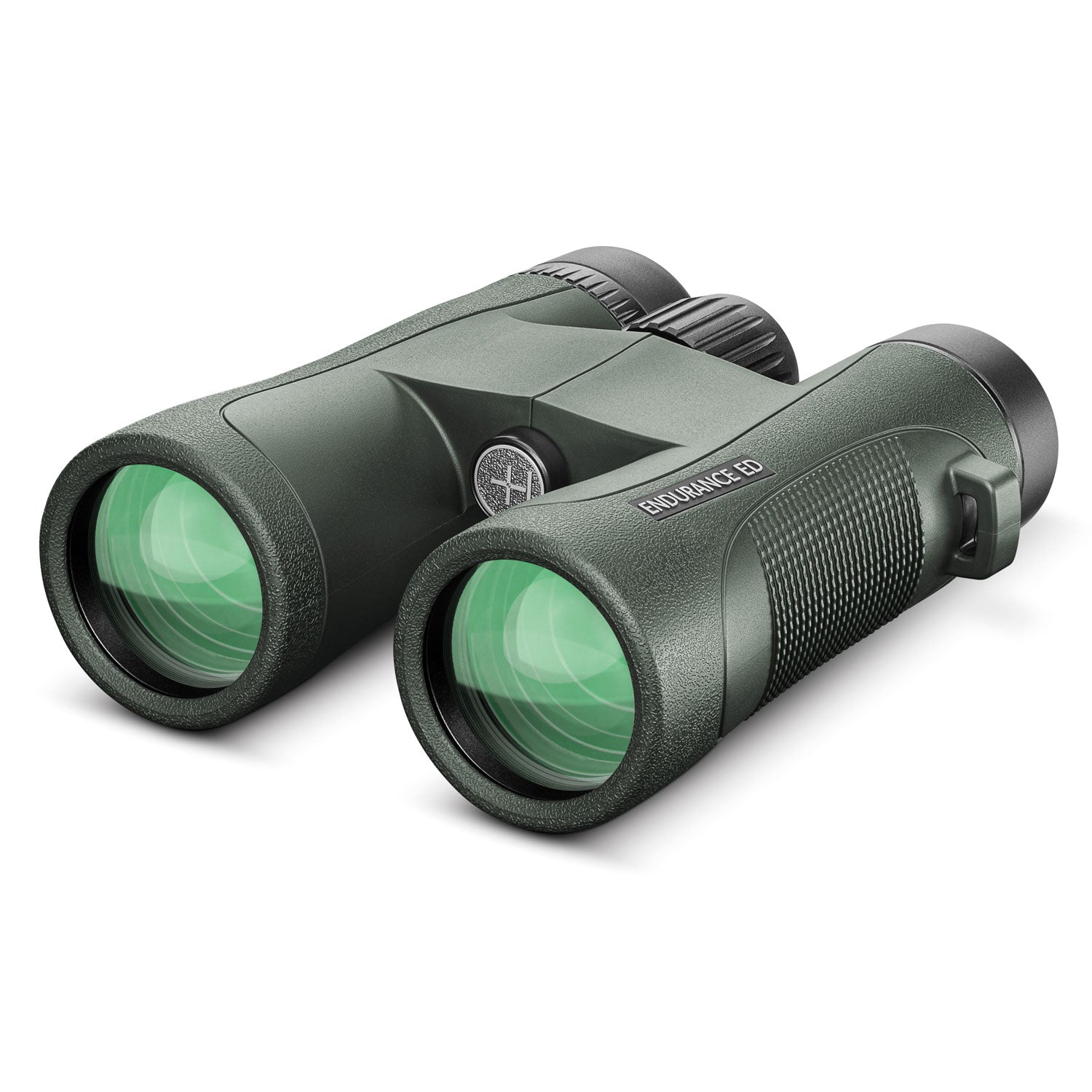
| Hawke Endurance ED | ED lenses, phase-corrected BAK-4 | 133m | 705g | 17mm | Lifetime | Under £300 |
| Viking Merlin ED | ED lenses, dielectric BAK-4 | 142m | 720g | 17.2mm | 10 years | Under £300 |
| Bresser Pirsch ED | ED lenses, dielectric roof prisms | 125m | 636g | 17.1mm | Lifetime | Under £300 |
| Hawke Frontier HD X | Dielectric BAK-4, no ED | 142m | 725g | 18mm | Lifetime | £300 to £400 |
| Celestron TrailSeeker ED | ED lenses, BaK-4, fully multi-coated | 142m | 666g | 17.2mm | See listing | £300 to £400 |
| Bushnell Engage EDX | ED Prime lenses, BaK-4 | 142m | 666g | 19mm | Lifetime | £300 to £400 |
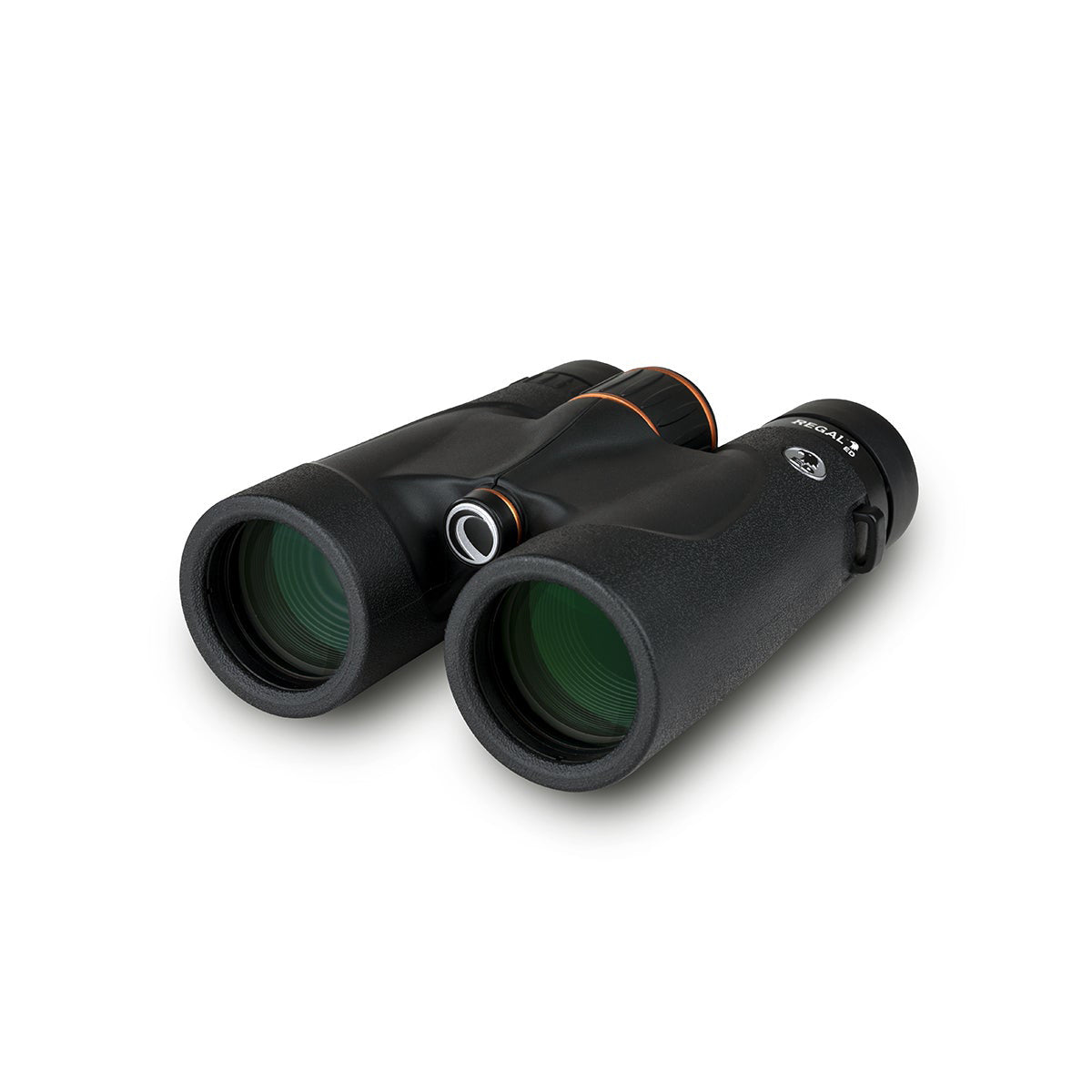
| Celestron Regal ED Flat Field | ED and field flattener lenses | 140m | 768g | 22.5mm | Lifetime | £300 to £400 |
| RSPB HD | Double ED lenses, BaK-4 prisms | 126m | 700g | 20.3mm | 10 years | £300 to £400 |
| GPO Passion ED | ED lenses, Schmidt-Pechan prisms | 142m | 740g | 18mm | 10 years | £350 to £410 |
| Kowa BD II XD | XD extra-low dispersion lenses | 143m | 640g | 17mm | 10 years | £300 to £400 |
| RSPB Harrier X | ED lenses, SHR coated BAK-4 | 142m | 716g | 18.4mm | 10 years | £300 to £400 |
| Viking Osprey ED | ED lenses, dielectric BAK4 | 142m | 717g | 18.4mm | 10 years | £400 to £500 |
| RSPB Buzzard ED | ED lenses, phase-coated prisms, field flatteners | 142m | 740g | 18.4mm | 10 years | £500 to £750 |
| RSPB HDX | ED lenses, SHR prism coating | 131m | 680g | 17.2mm | 10 years | £500 to £750 |
| GPO Passion HD | HD lenses, BAK4 Schmidt-Pechan, drop coating | 125m | 830g | 19.5mm | 10 years | £750 plus |
The Endurance and Frontier pairs come in black, green or grey and the GPO Passion ED in black, green or brown, with identical optics in each finish.
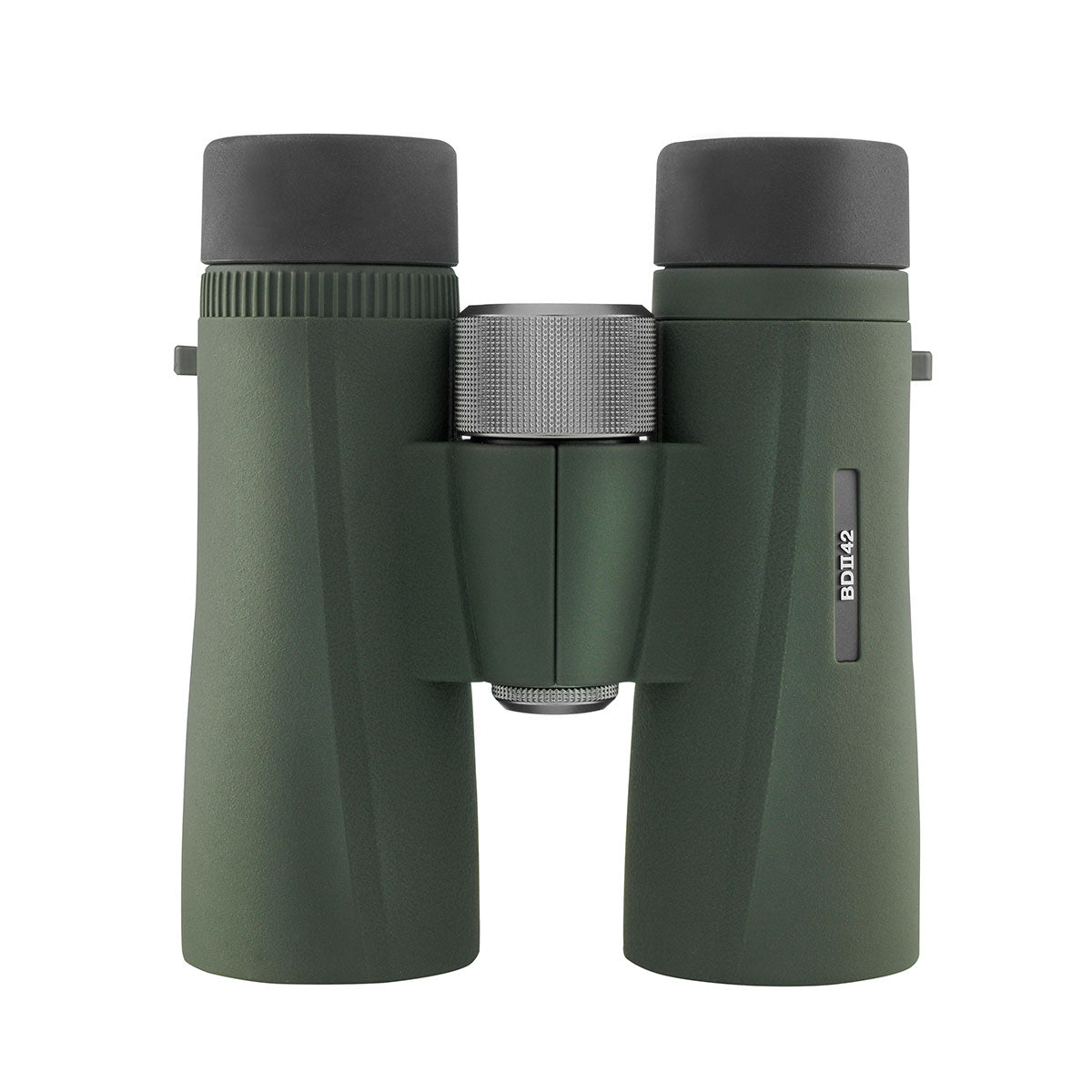
Under £300: the Hawke Endurance ED, Viking Merlin ED and Bresser Pirsch ED all bring ED lenses to entry money. The Endurance focuses down to 2m, handy for butterflies and dragonflies, and it comes with a no-fault lifetime guarantee. The Merlin has the wider 142m view; the Bresser is the lightest pair on the page. Below this sit budget porro prism pairs like the Nikon Action 8x42: bright and cheap, but bulkier and not as well sealed.
£300 to £400: the busiest band and the best mid-range value for most people. The Celestron TrailSeeker ED was the overall top pick in the Cornell Lab test, with the Kowa BD II XD tied second alongside the Nikon Monarch M7, and the cheaper Nikon Monarch M5 also among its top picks. The RSPB Harrier X and HD come from the charity's own range, and the Engage EDX has EXO Barrier coatings that shed rain and fingerprints. Compare whole ranges on our Kowa binoculars, Celestron binoculars and Bushnell binoculars pages.
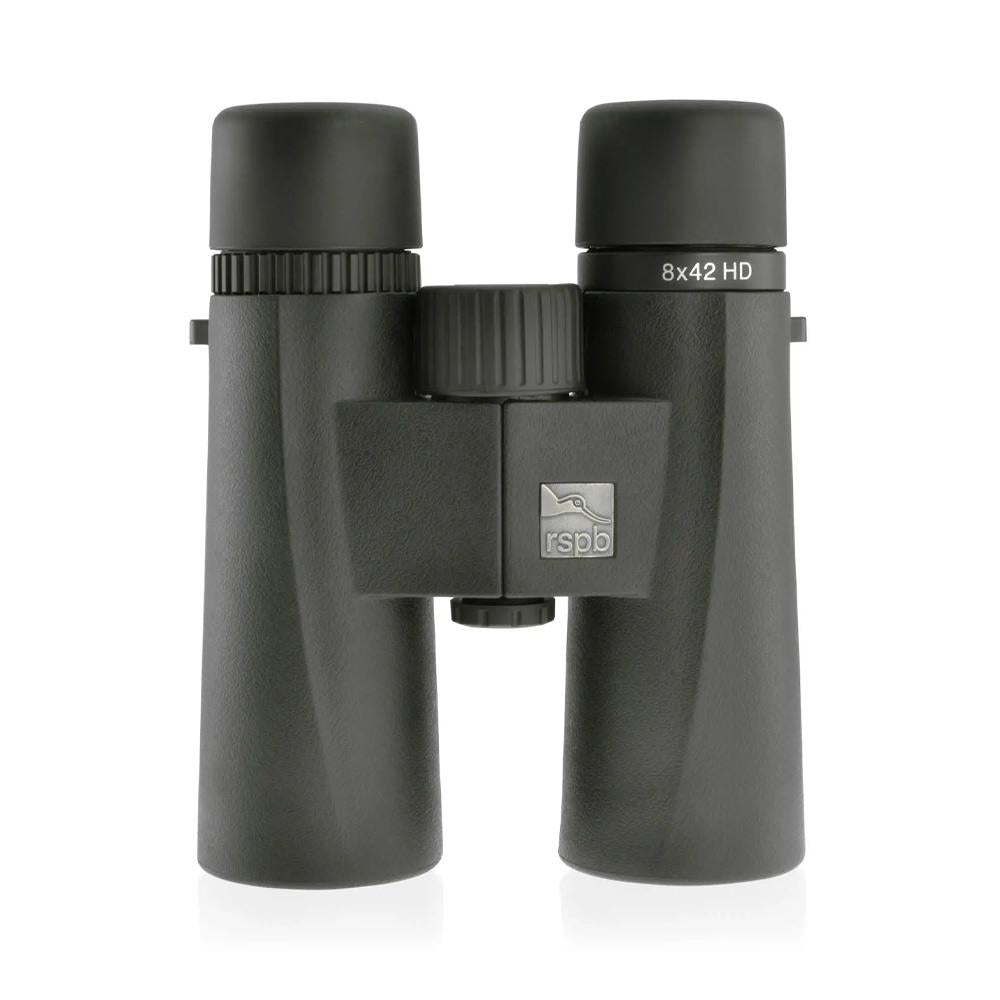
£400 to £750: the Osprey ED, RSPB Buzzard with field flattening lenses, and the 680g RSPB HDX. See all of them on RSPB binoculars and Viking binoculars.
£750 plus: the GPO Passion HD, heavier at 830g but with 19.5mm eye relief and GPO's water-shedding drop coating. More on GPO binoculars and Hawke binoculars. Above this, direct sellers like Maven come in, with Maven's B1.2 at around £900, and alpha glass such as the Zeiss Victory SF or Vortex Razor runs to well over £1,500.
Three adjustments make any pair look sharper. First, fold the barrels until you see one round image, not two overlapping circles. Second, set the eyecups: twisted up if you don't wear glasses, down if you do. Third, set the dioptre: close your right eye and focus on something with the centre focus wheel, then close your left eye and turn the dioptre ring, usually on the right eyepiece, until it is sharp too. Note the setting, and from then on you only need the centre wheel. The Which? binoculars buying guide has more tips on trying a pair before you buy.
Yes, they are the standard choice. The wide view, bright image and steady handheld picture suit woodland, gardens, reserves and mixed countryside. Only if most of your birds are far off, on estuaries or moorland, is a 10x worth the narrower view.
For one pair to do everything, 8x. It shows a wider scene, is easier to hold still and is a touch brighter at dusk. A 10x shows more detail on distant birds. In the same series the two sizes usually weigh within 20g to 30g of each other.
Most are. Twist the eyecups fully down and look for 17mm or more of eye relief in the table above; every pair on this page has at least that, and the Celestron Regal has the most.
Yes. The 5.25mm exit pupil makes them bright enough for the Moon, the Pleiades and the Milky Way. Rest them on a wall or fit a tripod adapter to keep the stars still.
Partly. Our pupils open less with age, so a 5.25mm beam may be slightly larger than an older eye can use in the dark. In daylight it still makes the view easier to line up, which is why the size suits everyone.
For regular use, from about £270. That buys ED glass, coated prisms, proper waterproofing and a long guarantee. Spending more mainly adds image quality: a wider, flatter view, better colour and lighter bodies. If that is the case for you, the £400 to £750 band is where the gains show.